
“There’s a garden under that snow. / Deep in cozy soil, stretch, unfurl. / Plants need privacy, did you know? / Yes, there’s a garden under that snow. / Plants carry the light required to grow, / While winter sky is all storm and swirl.”
Winter Garden by Irene Latham
“There’s a garden under that snow.
Deep in cozy soil, stretch, unfurl.
Plants need privacy, did you know?
Yes, there’s a garden under that snow.
Plants carry the light required to grow,
While winter sky is all storm and swirl.”
Winter Garden by Irene Latham
With a bit of planning, your garden can be just as lovely in December as it is in May. Especially if you choose perennials, trees and shrubs that add some winter interest to your beds and borders. When you look, you can find beauty in a dusting of snow settled onto a piece of sculpture, a rainbow of light cast by sunshine through a gazing globe, or a seed head accentuated by a layer of morning frost.
The stately Joe Pye Weed has a commanding presence in the garden. Although it emerges late in the spring, its exuberant growth and vigor quickly catch up to its perennial companions. Some of the tall varieties make great additions to your winter garden. The strong stems grow to six feet, stand up to ice and snow, and the flower heads are very persistent as well. Birds are often seen taking refuge in and among the clumps, animating the area with lots of flitting and fluttering. Joe Pye is one of our native plants that has recently gotten more attention in garden design due to the sudden surge in popularity of butterfly gardens.
This year some of our Allium seed heads persisted all summer and it looks like they will be part of our winter landscape. Remember, Alliums are the large, spherical, pink and purple flowers you see blooming in early summer. Not only are the flower heads magnificent, the dried heads are very ornamental later in the season. The Giant Alliums grow from large bulbs that are planted in the fall along with your tulips and daffodils. They are long-lived perennials and are not attractive to those very aggravating deer and rabbits. The seed heads can be left in their natural place or easily plucked from the garden to be used in arrangements indoors or out.
There are many trees and shrubs that create very obviously beautiful forms in the garden. Anything twisted, contorted or weeping come immediately to mind. But let’s look at some more subtle winter attributes. There are a few mornings every winter when the level of humidity in the air is at the exact ratio to the temperature. And when you look out the window, every branch and twig is covered with the very magical hoar frost. And you’re especially lucky if cloud cover doesn’t obstruct the rising sun, because then the whole world seems to sparkle like diamonds. We like a few trees and shrubs with lacy, delicate branches to hold Jack Frost’s crystalline structures.
You can’t forget about persistent fruit!. We like fruiting plants that can provide bright color in the dark doldrums of January and February. Crabapples are good, but what are some other options? Our native Winterberry, Ilex verticillata, is a particular favorite. Or look at the new varieties of the old-fashioned Beautyberry, Callicarpa. Its branches can be completely covered with tiny, bright purple fruits. And don’t fret about harvesting those branches. Since Beautyberry blooms and fruits on new wood, it benefits from hard, yearly pruning.
Some of our most cherished garden images involve the strategic and sometimes serendipitous placement of statuary and other ornaments. Metal ornaments can be left outside as long as you don’t mind a little rust. Of course, rust is in style right now for garden decor, so who cares? Metal obelisks and garden stakes can be great fun for the birds to perch on or can be lighted for the holidays. Ice crystals formed on metal objects can be stunning enough to photograph. The beauty of the season can be found everywhere, if you only take time to look.
Finally, don’t forget about evergreen plants that epitomize the winter season. The shades of green offer a respite from the endless gray days of winter. They offer shelter for a windy corner, provide habitat for any over-wintering birds and often create microclimates in our yards for a few specimen plants.
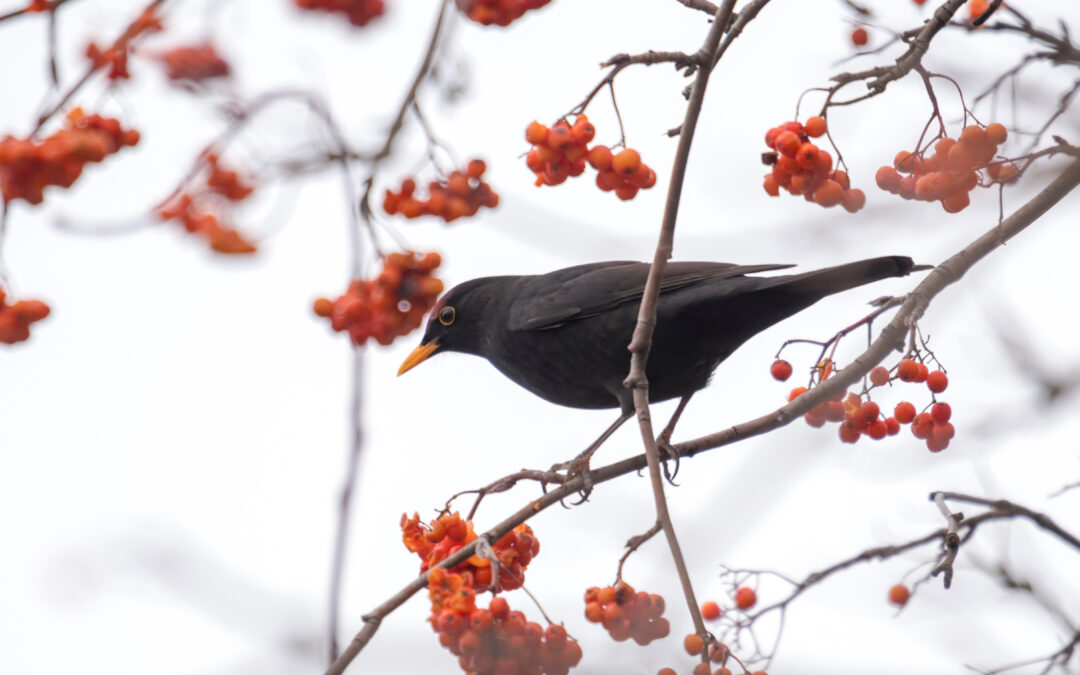
And did you notice that many of the plants we like to grow are also great for attracting birds to the garden? Birds are a key element in our winter landscape. The static beauty of the plant world at rest, punctuated with the spectacular colors and vibrant movement of birds is a match made in heaven. Bird feeders can also make wonderful garden ornaments. There are so many decorative styles to choose from these days, from the recycled barn-wood look to the ultra-modern plexi-glass tube feeders. There are feeders and birdhouses that mimic miniature cathedrals and chalets and some that look like cars. You can certainly make a statement in your aviary landscape whether it is whimsical or artful. Mix feeders with some garden stakes for perching and you’ve set the stage for some entertaining action. You’ll probably have every Goldfinch in town at your feeders. And your cats will be totally enthralled, too.
When you look, you can find beauty in a dusting of snow settled onto a piece of sculpture, a rainbow of light cast by sunshine through a gazing globe or a seed head accentuated by layer of morning frost.
The stately Joe Pye Weed has a commanding presence in the garden. Although it emerges late in the spring, its exuberant growth and vigor quickly catch up to its perennial companions. Some of the tall varieties make great additions to your winter garden. The strong stems grow to six feet, stand up to ice and snow, and the flower heads are very persistent as well. Birds are often seen taking refuge in and among the clumps, animating the area with lots of flitting and fluttering. Joe Pye is one of our native plants that has recently gotten more attention in garden design due to the sudden surge in popularity of butterfly gardens.
This year some of our Allium seed heads persisted all summer and it looks like they will be part of our winter landscape. Remember, Alliums are the large, spherical, pink and purple flowers you see blooming in early summer. Not only are the flower heads magnificent, the dried heads are very ornamental later in the season. The Giant Alliums grow from large bulbs that are planted in the fall along with your tulips and daffodils. They are long-lived perennials and are not attractive to those very aggravating deer and rabbits. The seed heads can be left in their natural place or easily plucked from the garden to be used in arrangements indoors or out.
There are many trees and shrubs that create very obviously beautiful forms in the garden. Anything twisted, contorted or weeping come immediately to mind. But let’s look at some more subtle winter attributes. There are a few mornings every winter when the level of humidity in the air is at the exact ratio to the temperature. And when you look out the window, every branch and twig is covered with the very magical hoar frost. And you’re especially lucky if cloud cover doesn’t obstruct the rising sun, because then the whole world seems to sparkle like diamonds. We like a few trees and shrubs with lacy, delicate branches to hold Jack Frost’s crystalline structures.
You can’t forget about persistent fruit!. We like fruiting plants that can provide bright color in the dark doldrums of January and February. Crabapples are good, but what are some other options? Our native Winterberry, Ilex verticillata, is a particular favorite. Or look at the new varieties of the old-fashioned Beautyberry, Callicarpa. Its branches can be completely covered with tiny, bright purple fruits. And don’t fret about harvesting those branches. Since Beautyberry blooms and fruits on new wood, it benefits from hard, yearly pruning.
Some of our most cherished garden images involve the strategic and sometimes serendipitous placement of statuary and other ornaments. Metal ornaments can be left outside as long as you don’t mind a little rust. Of course, rust is in style right now for garden decor, so who cares? Metal obelisks and garden stakes can be great fun for the birds to perch on or can be lighted for the holidays. Ice crystals formed on metal objects can be stunning enough to photograph. The beauty of the season can be found everywhere, if you only take time to look.
Finally, don’t forget about evergreen plants that epitomize the winter season. The shades of green offer a respite from the endless gray days of winter. They offer shelter for a windy corner, provide habitat for any over-wintering birds and often create microclimates in our yards for a few specimen plants.
And did you notice that many of the plants we like to grow are also great for attracting birds to the garden? Birds are a key element in our winter landscape. The static beauty of the plant world at rest, punctuated with the spectacular colors and vibrant movement of birds is a match made in heaven. Bird feeders can also make wonderful garden ornaments. There are so many decorative styles to choose from these days, from the recycled barn-wood look to the ultra-modern plexi-glass tube feeders. There are feeders and birdhouses that mimic miniature cathedrals and chalets and some that look like cars. You can certainly make a statement in your aviary landscape whether it is whimsical or artful. Mix feeders with some garden stakes for perching and you’ve set the stage for some entertaining action. You’ll probably have every Goldfinch in town at your feeders. And your cats will be totally enthralled, too.